Showing posts with label Concept Car. Show all posts

Wednesday, February 3, 2010

Venturi Electric Sports Car Volage Concept

Venturi Electric Sports Car Volage Concept

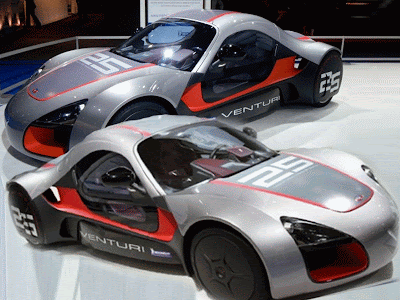
The result of close technological collaboration between Venturi Automobiles and Michelin, the Venturi Volage, marks a major step forward in the evolution of the Automobile. This new Venturi incorporates innovations which have enabled radical changes in terms of the vehicle’s architecture, style, dynamic behaviour and, more generally, the design of a modern vehicle. All these changes constitute several world premières which, with the presentation of the Venturi Volage, reinforce Venturi’s capability for constant innovation, as well as its position as the most advanced company in the field of electric vehicles.
Venturi Electric Sports Car Volage Concept

The Volage takes the electric sports car concept and really runs with it — the all carbon-fiber car is equipped with the first application we've seen of the Michelin Active Wheel, the compact unit using in-wheel electric drive motors is installed at all four corners with a suspension driven by a second set of e-motors. With 4 drive wheels with active suspension, the Venturi Volage has no equivalent. “Michelin Active Wheel” technology in fact incorporates 2 electric motors per wheel (1 for suspension and 1 for drive), ie. a total of 8 electric motors piloted in real time by spearhead electronics.
Venturi Electric Sports Car Volage Concept

Playing down the mechanical aspect in favor of electronics, close to the concept of a robot, this car belongs to a new era, the digital era. Thanks to a dashboard touch screen, the driver can configure the vehicle entirely as he wishes. This total control marks significant progress in terms of management, particularly of the energy stored in the car’s batteries: the driver can, for example, decide to give preference in certain cases to range rather than power, comfort rather than speed, an important factor for an electric car.
Venturi Electric Sports Car Volage Concept

The only part that the Venturi Volage shares with the Venturi Fétish is its carbon fiber bodywork. Developed by the Venturi Design Office, this body is still a unique concept worldwide, as it is the only one to have been specifically designed to be that of an electric car and thus carry batteries within its very structure. The ideal distribution of the Venturi Volage’s masses - 45% at the front, 55% at the rear – and its perfectly mastered weight of 1,075 kilos enable it to attain 100 km/hr (62 mph) in less than 5 seconds.
Venturi Electric Sports Car Volage Concept

A real demonstration of spearhead technology, the car presented in its world première is entirely operational and prefigures the production of a limited series of this model, scheduled as from 2012. Like the Venturi Fétish assembled in our workshops in Monaco, the Venturi Volage will be assembled by hand, in the form of very limited production. 
Venturi Electric Sports Car Volage Concept

The technological repercussions of these two cars positioned at the very top end of the market are to be found on other vehicles bearing the Venturi brand, enabling as many people as possible to benefit from the firm’s advances in the field of sustainable mobility.

Thursday, January 7, 2010

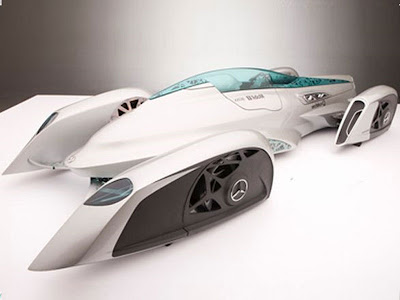
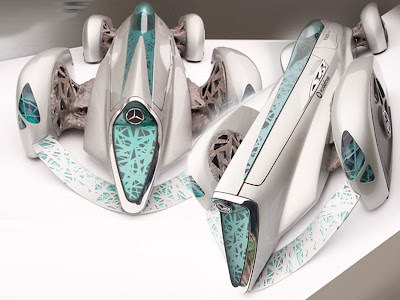
Mercedes-Benz BlitzenBenz Concept Car Production year theoretical 2025

Mercedes-Benz BlitzenBenz concept car

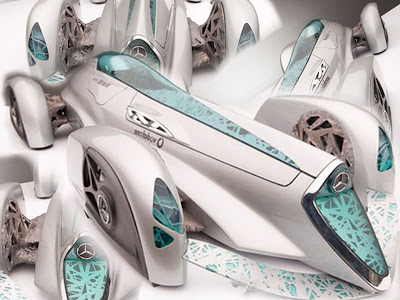
Mercedes-Benz BlitzenBenz concept car Production year theoretical 2025. Brilliant and outstanding is what every car lover will exclaim when will see this BlitzenBenz concept car. The Mercedes-Benz BlitzenBenz concept was created by George Yoo, a designer at Mercedes-Benz Research and Development in Carlsbad, California. The BlitzenBenz was developed during his final year at the Art Center College of Design in Pasadena.
Mercedes-Benz BlitzenBenz concept car

Created by George Yoo as a futuristic racing vehicle, BlitzenBenz concept is derived from two different sources. And let me tell you the roots of its design are in the past. The main inspiration behind the idea is from original Blitzen-Benz from 1909 that had a long tubular shape and rear cab positioning. On the other, Alex Erlandson work of creating sculptures from trees that were grown into certain shapes/patterns influenced Yoo considerably to contemplate what if automotive parts were to be grown and tamed to hold certain shapes.
Mercedes-Benz BlitzenBenz concept car

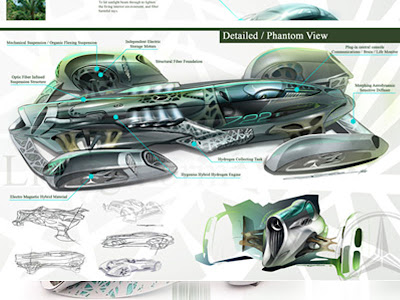
Obviously the technology is not quite there yet to create such a vehicle, but the current research into nanotechnology is paving the way for intelligent and adaptable components which can be grown instead of manufactured. It's an incredibly interesting prospect which would completely alter the way cars are built, maintained, upgraded and recycled.
Mercedes-Benz BlitzenBenz concept car

The exterior design is a base for the organic structure and the individual wheel pods are there to sense as to when the inside electric motors need to be cooled down. When the cooling will be required, these structures will open up in the same way as the plants do to receive the vital sunlight.
Mercedes-Benz BlitzenBenz concept car

To run this Mercedes-Benz BlitzenBenz, there is an advanced next-generation Hygenius hybrid hydrogen engine and four in-wheel electric motors. The inspiration for the blue lightening system came from bioluminescent capabilities of deep sea creatures. Also, a hydrogen storage tank is just below the cockpit and the fuel level is shown in a small window.
Mercedes-Benz BlitzenBenz concept car

Though, woefully, there is no technology to make this vehicle as such, but the progressing research into nanotechnology will surely open the way for components that can be grown than manufactured, changing the way cars will be built or maintained in future.

Monday, January 4, 2010

Ford Rescue X Concept created at Ford of Europe design studio By Robert Engelmann

Ford Rescue X Concept By Robert Engelmann

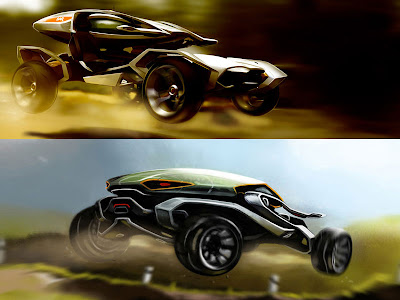
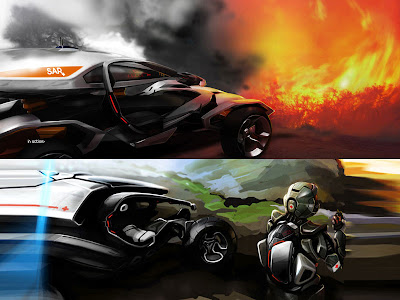
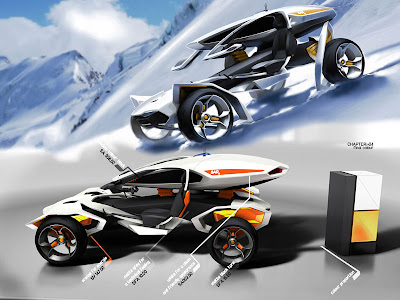
The Ford Rescue X design proposal from Robert Engelmann is a tough vehicle designed for rescue operations in treacherous terrains. The futuristic search and rescue vehicle is designed to reduce time consumption in medical emergencies. The Ford Rescue X Concept is a study of a futuristic search and rescue vehicle designed for rough terrains that features a dedicated medical module and Computer Aided Surgery equipment. It was designed by German product design graduate Robert Engelmann.

Ford Rescue X Concept By Robert Engelmann

Ford Rescue X Concept Rendering Ford Rescue X Concept Rendering The car has an original layout, with an open structure that integrates two seats for the driver and another operator, and a dedicated closed medical module, which is connected to the chassis by means of a mechanical balancing system. The medical module floats above the main structure and protects the passenger like an egg. A display window shows the passenger's health conditions.
Ford Rescue X Concept By Robert Engelmann

One of the seats has an integrated first aid pack that can be quickly released, while the rotating wheel arches on the concept allow it to move through snow covered/ icy terrains. The medical module has a system to allow remote Computer Aided Surgery (CAS). The concept has an electric drivetrain utilizing four suspension-mounted motors.
Ford Rescue X Concept By Robert Engelmann

Ford Rescue X Concept Ford Rescue X ConceptThis contributes to the safety of the injured person and allows a specialist to remotely operate the integrated medical equipment in order to do an emergency surgery anywhere. Ford Rescue X Concept - Design Panel The rotating wheelarches can be turned into special breaks for extreme conditions such as on the snow or icy terrains. A backpack with first aid tools is integrated in the seat and can be quickly released. The integrated medical equipment also includes a computer tomograph and a CAS system (Computer Aided Surgery).

Ford Rescue X Concept By Robert Engelmann

The project was created at Ford of Europe design studio by Robert Engelmann for his product design diploma at HBK Saar, Germany.

Saturday, December 26, 2009

2010 Ford GT90 Super Sport Car Concept going to auction

2010 Ford GT90 Super Sport Car Concept

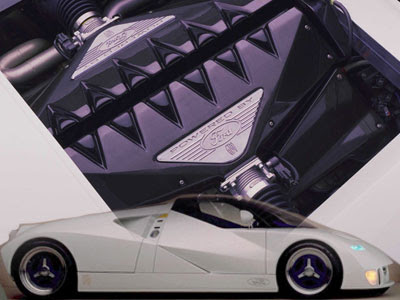
If Ford first introduced the GT90 Concept at the 2010 Detroit Auto Show next month, it would still be one of the most eyecatching cars on the show floor. What's amazing is that Ford unveiled the GT40 successor nearly 15 years ago. What's more, even by today's standards it's still a supercar among supercars.
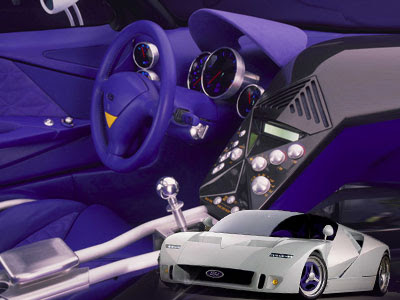
The quad-turbocharged 6.0-litre V12 puts out an estimated 720 horsepower, the body is constructed completely of carbon fiber and top speed is somewhere in the 400 kph range. The only hints that it's not a modern supercar are the all-blue interior and wheels that look dated now.
So what's all the fuss about the GT90 Concept now? RM Auctions in the States has just announced that it will be offering the concept car at its upcoming Arizona sale. That's right, this is your chance to own one of the coolest concept vehicles of all time. This is the first time that the GT90 Concept has ever been publicly for sale at auction, and RM claims that it is in "excellent running condition, having been properly stored and maintained over the year." No estimated on price is given, but we're guessing it will take a large suitcase of cash to take the car home.
2010 Ford GT90 Super Sport Car Concept

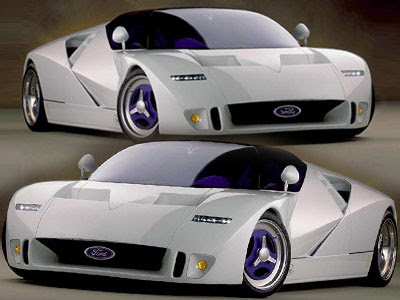
The one-off GT90 Concept Car, labeled immediately as "the world's mightiest supercar" by Ford Motor Company on December 6, 1994, was the spiritual successor to the Ford GT40, the product of a colossal feud in the early 1960s between the Blue Oval from Dearborn and the Prancing Horse of Northern Italy. The GT90 draws from the design cues of its heritage and pays homage to the famed Le Mans-winning Ford GT40s of the 1960s, which were created after the failed attempt by Ford to buy out Ferrari.
At a development cost in the neighborhood of $3 million, the GT90 was certainly worthy of pulling styling cues from the original Ford GTs, and although it was never meant for production, it was built according to a Ford press release as a "test bed for technology, engineering and design concepts, and driver-oriented features that eventually may be used in Ford production vehicles."
Officially unveiled to the public in January 1995 at the Detroit Auto Show, the GT90 is finished in bright white with a bright blue and carbon fiber interior. It features a mid engine quad-turbocharged V12 that produces an estimated 720 horsepower and 660 pound-feet of torque. As a result, it had a claimed top speed of 253 mph, which even by today's standards would make it one of the fastest production cars in the world – faster even than a McLaren F1, which was widely considered the world's preeminent supercar at the time.
2010 Ford GT90 Super Sport Car Concept

The engine, which was a 48-valve six-liter V12, had to be combined together with four Garrett Systems T2 turbochargers in order to reach its estimated 720 horsepower and was based on the Ford Modular engine. Created by using parts of two Lincoln V8 engines, engineers removed the last pair of cylinders from the rear of one engine and the first pair of cylinders from the front of the other engine. The cut-down engines were then welded together with the final result being a 90-degree V12, which utilized a 90.2 mm bore and a 77.3 mm stroke to achieve maximum power.
The GT90 features the FFD-Ricardo five-speed manual gearbox found on the XJ220 and, considering the torque load that it is designed to handle, is noted as having a relatively light shift quality. Also borrowed from the XJ220 comes the all around double wishbone suspension that was designed to enable the car to handle well at top speeds.
2010 Ford GT90 Super Sport Car Concept

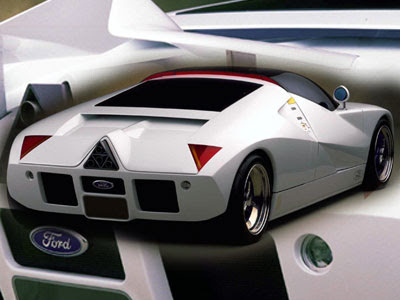
Using Ford's new "Edge" design philosophy, the car incorporated advanced technology with a mixture of flat planes, angles, glass and triangular shapes that seemingly all collided together. The GT90 was the first car created using this new styling directive from Ford, which went on to be responsible for the creation of other Ford products like the Ka and Cougar. The effect is most impressive and a wonderfully executed stylistic throwback to its GT40 predecessor, which at once stays true to its heritage but acknowledges the advances in modern design. Taken directly from race car technology, the GT90 body panels are molded out of carbon fiber while the chassis is formed out of a honey-comb sectioned aluminum monocoque.
The GT90 is a test bed of advanced technology and design. It sports a tinted, laminated glass bubble over the cockpit and a spoiler that rises off the rear deck at high speeds. According to Ford, it has a "design that tightly enclosed its mechanicals with no wasted space; high tech lighting and blind-spot detection systems; and tiles like those on the space shuttle to shield the V12's exhaust outlets."
2010 Ford GT90 Super Sport Car Concept

After its unveiling in Detroit, the GT90 made its rounds on the Auto Show Circuit in 1995, traveling around the world to Frankfurt and as far away as Tokyo. With few other showings in between, the car recently was shipped over to Europe to be on display in the Ford of Europe 2008 exhibit at the Goodwood Festival of Speed. After returning home, the car was shipped to Alabama where it was on display as part of the Mustang 45th Anniversary Celebration.
This superb concept car remains in excellent running condition, having been properly stored and maintained over the years in between its show appearances. RM Auctions is proud to publicly offer the GT90 for the first time ever at auction. A remarkable one-off piece of automotive history and cutting-edge design, its offering may very well be a once in a lifetime opportunity for Ford devotees and concept car enthusiasts.

Thursday, December 24, 2009

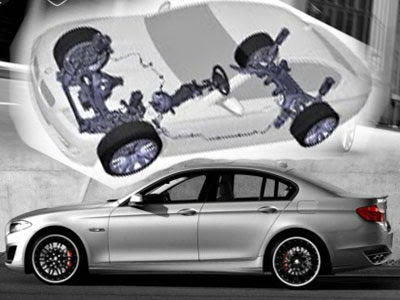
2011 BMW 5-Series F10 Sports Concept plans by Lumma Design, TopCar, and Cardi that have joined forces to offer a new Sport package

2011 BMW 5-Series F10 Sports Concept plans
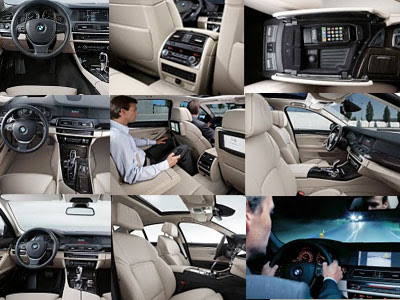
Two Russian tuning firms and a German company have teamed up to offer a new kit for the 2011 BMW 5-Series F10. TopCar and Cardi, from Russia, and Lumma Design have joined forces to create an aggressive styling package which will likely boost performance.
The brand-new 2011 BMW 5-Series hasn't even made its motor show debut yet, but tuners are already actively working on their plans to present an array of performance and cosmetic goodies for the Bavarian automaker's premium sedan.
2011 BMW 5-Series F10 Sports Concept plans
German and Russian tuning houses are joining efforts to create bodykit and tuning packages for the F10 5-series. Full set of renderings inside. One of the first proposalscomes from a trio of companies, Russia's TopCar and Cardi, and Germany's Lumma Design, that have joined forces to offer a new sport package for the Bimmer.
2011 BMW 5-Series F10 Sports Concept plans
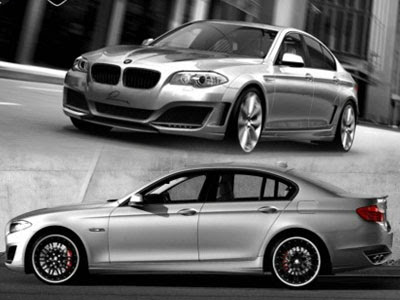
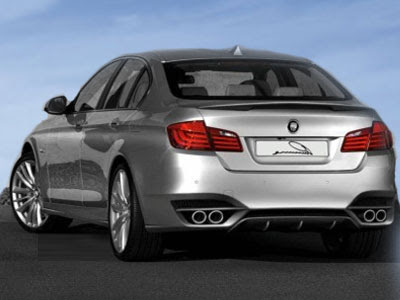
TopCar and Cardi are the russian tuners and Lumma Design is the german tuner. Judging by the included renderings, the car will maintain a bulging nose, with new carbon fiber front lip installed underneath. Their renderings show an aggressive front end package including a new front bumper aggressively sculpted with huge air inlets, carbon fiber front lip, LED lighting and honeycomb grill. TopCar and Cardi will handle the design aspect of the project while Lumma Design will be responsible for the manufacturing of the kit as well as the performance upgrades. One version of the kit also features super wide wheel fenders and aggressive side skirts. The rear features a carbon fiber rear trunk spoiler, together with carbon fiber rear diffuser, quad exhaust pipes. Two types of wheel options will be available.
2011 BMW 5-Series F10 Sports Concept plans
Although the three tuners have not disclosed any specific details about the package, they did release a set of photoshoped images that show a new wide bodykit trimmed in carbon fiber that consists of new bumpers, fender extensions, side skirts and a boot lid spoiler.2011 BMW 5-Series F10 Sports Concept plans
In addition, the tuners previewed three different alloy wheel designs for the 2011 5-Series.
This custom F10 5-series is expected to debut in April 2010, along with details of the full performance tuning package.

Wednesday, December 23, 2009

2010 BMW ActiveE Concept Car Powered By A New Synchronous Electric Motor Specially Developed For This Vehicle

2010 BMW ActiveE Concept Car

Introducing the BMW ActiveE Concept, the latest electric vehicle project under BMW Group's initiative to produce vehicles that explore solutions to minimize environmental impacts while preserving the kinetic driving experience for which BMW has long been known. The BMW ActiveE Concept follows the all-electric MINI E as the second large-scale electric vehicle test program to be conducted in the hands of interested customers.
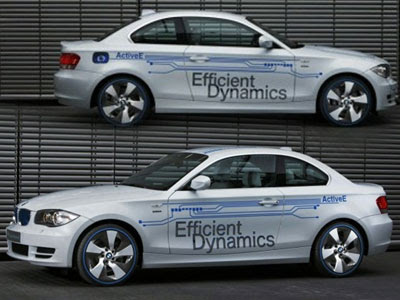
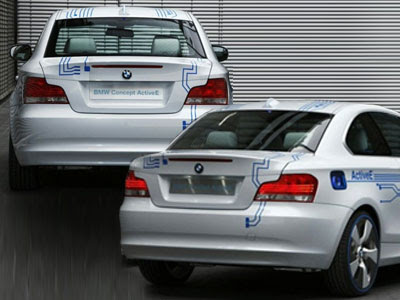
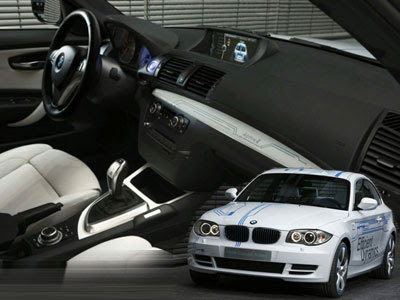
The BMW Concept ActiveE is based on the BMW 1 Series Coupe. The BMW Concept ActiveE is powered by a new synchronous electric motor specially developed for this vehicle. Its maximum output is 125 kW/170 bhp, the maximum torque of 250 Nm / 184 lb-ft is available from standing as is typical for electric motors and remains available over an unusually broad load range.
2010 BMW ActiveE Concept Car

Predicted driving performance figures: acceleration from zero to 60 km/h (37mph) in less than 4.5 seconds and from zero to 100 km/h (62mph) in less than 9 seconds, maximum speed: approx. 145 km/h (90 mph, electronically limited). As with the MINI E, the real-world range is expected to be about 160 km / 100 miles on a single charge, depending on conditions (FTP72 cycle range is calculated to be 240 km / 150 miles in simulation).
2010 BMW ActiveE Concept Car

The electric drive system draws its energy from new, advanced lithium-ion battery pack developed jointly by BMW and the co-operation partner SB LiMotive especially for the BMW ActiveE Concept. They enable a range of approx. 160 kilometres (100 miles) in everyday use. An intelligent battery management system helps achieve this range largely independently of external climatic conditions. Additionally, the charging period required for the lithium-ion batteries is very short. On the European power grid, the battery pack can be fully charged in just 3 hours at a wall box with a current of 50 ampere at 230/240 volts. In North America, using a high-current (32 ampere continuous) residential wall box, the charge time is about 4.5 hours.
2010 BMW ActiveE Concept Car

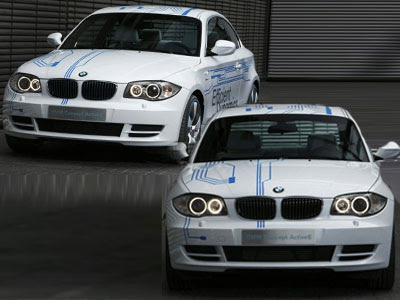
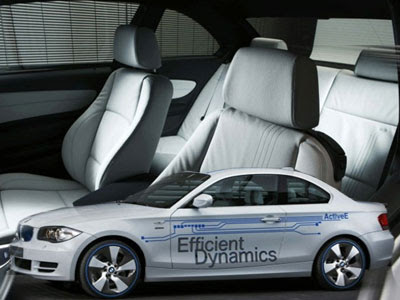
There is a clearly recognizable differentiation from the serial production model of the BMW 1 Series Coupe with the body finish in Liquid White metallic, as well as graphic elements derived from printed circuits in Electric Blue on the hood, doors, roof and trunk lid, as well as the lettering “ActiveE”, “eDrive” and “EfficientDynamics” on the doors and side panels. Specific light-alloy wheel wheels, the lack of an exhaust system and blue illuminated elements such as the roof fin and charging connection highlight the special character of this electrically powered concept vehicle.
2010 BMW ActiveE Concept Car

In the BMW ActiveE Concept, new BMW ConnectedDrive services are presented which have been designed exclusively for use in an electric vehicle. This includes specific remote functions which enable the use of a mobile phone to check the charge status of the battery, search for public charging stations and activate the vehicle’s auxiliary heating and air conditioning functions. The BMW ActiveE Concept creates a basis for the expansion and intensification of this field testing on electro-mobility, oriented towards enabling large-scale production in the future. The aim is to produce a fleet to a scale which will exceed that of the MINI E. The BMW ActiveE Concept moves a little closer towards the future of an individual mobility which will combine driving pleasure with CO2-free travel.

Tuesday, December 8, 2009

2009 Audi Avatar concept Car is an electric powered supercar concept

2009 Audi Avatar concept Car

The Audi Avatar is a concept vehicle which was created by Edwin Conan (Yi Yuan), a graduate of RMIT (Royal Melbourne Institute of Technology) University in Australia. The Avatar was developed during Edwin's final year at the university as part of his degree project.
The Avatar is an electric powered supercar concept which is designed for about 20-25 years in the future. The shape was inspired by the 1937 Auto Union Type C Streamline racing car, and both cars - even though they are separated by a century - share the same clinical lines and pronounced wheel arches.
2009 Audi Avatar concept Car

There are no conventional doors to the Avatar, instead the vehicle utilizes a three-part canopy which opens upward to provide entry and exit. The main canopy opens forward together with the steering wheel and the dashboard, while two smaller canopies above the passenger seats open backwards. At the same time a panel in the bodywork drops down to act as a step.
2009 Audi Avatar concept Car

The interior of the Audi Avatar features a three-seat layout with the driver sitting in a central position forward of the passenger seats. The driver is met with a futuristic dashboard which consists of a transparent LCD display which provides all essential driving data. In the center of the steering wheel is another screen which provides navigation information. Additional information can also be projected onto the canopy to provide a heads-up-display similar to those found in high performance aircraft.
Thanks to a drive-by-wire system the Avatar's steering wheel can be swapped out quickly and easily in favor of a joystick or even a keypad depending on driver preferences.
2009 Audi Avatar concept Car

Powering the Audi Avatar is an all-electric drivetrain which comprises of four individual electric motors (one for each wheel), and a pair of high-performance battery packs. The battery packs are split in two to provide better weight distribution, one is located at the front and one at the rear. In total the projected output is 544 horsepower, and 4,500 Nm (3,319 lb-ft) of torque. This gives the car a theoretical top speed of 223 mph (360 Km/h), and a 0-62 mph (100 km/h) time of 2.9 seconds.
2009 Audi Avatar concept Car

The wheels of the Avatar are housed inside the car's four 'legs'. The legs are constructed from a deformable material which allows it to change shape when the wheel is turned. To increase the vehicle's agility and handling, the Avatar features a four-wheel-steering system. The front wheels provide most of the steering, while the rear wheels can turn up to 10 degrees.

Sunday, December 6, 2009

2009 concept Chevrolet Camaro Dusk a very tailored look with a distinct American accent

Chevrolet Camaro Dusk 2009 concept

Urban professionals,Inspired by the style of young, the Camaro Dusk concept rolls with a contemporary tuner aesthetic. It is understatedly aggressive looking, with a lowered ride height, new 21-inch wheels, the rear spoiler from an SS model and a custom ground effects package.
“This is a car with an international flair, bringing the Camaro to a place it hasn’t traditionally been,” said Parker. “It is a very tailored look that is stylish and sophisticated, but with a distinct American accent.”
Chevrolet Camaro Dusk 2009 concept

The ground effects package includes a racing-inspired front splitter, rocker extensions and a rear diffuser. They are prototype parts that may enter production as dealer-available accessories at a later date; the same goes for the 21-inch wheels from BBS. Many of the details, such as the taillamp and fog lamp bezels, match the finish of the wheels, lending a more premium look to the car.
The Camaro Dusk’s body is painted Berlin Blue, while the ground effects are painted a contrasting color. Additional performance items include the exhaust system and Brembo brakes from a Camaro SS (with painted calipers). The interior is trimmed in stylish Jet Black and Sedona, with complementing features including footwell lighting, premium door sill plates and other details.
Chevrolet Camaro Dusk 2009 concept

Today’s young professionals expect advanced technology and premium audio options and this concept delivers with a crisp, well-tuned Boston Acoustics sound system, WiFi connectivity and a convenient cradle for an iPhone.
Camaro designers dreamed up half a dozen proposals for accessory graphics packages, with the intent of soliciting feedback from Camaro enthusiasts for possible production. Chevrolet then launched the graphics campaign in mid-October, asking Camaro fans on Facebook to pick their favorite design.
The top four designs were produced and brought to the SEMA Convention, where a Silver Ice Metallic Camaro will wear each contender on a different day. At the conclusion of the convention, after thousands of enthusiasts see the graphics on the car in person and on Facebook, another round of voting will occur. The top vote-getter will be considered for future production.
Chevrolet Camaro Dusk 2009 concept

“Camaro has thousands of fans on the various social media sites and this is a great way to demonstrate that Chevrolet is connected to our customers,” said Dewar. “With so many great designs to choose from, we’re sure the voting will be close, but whatever the outcome, the real winners will be the customers who personalize their Camaro with the winning graphics package.”
The Camaro Graphics display vehicle will be located prominently in the GM display during the SEMA Convention, starting on Tuesday, Nov. 3, 2009. At the close of the convention each day, the graphics package will be changed.

Friday, December 4, 2009

2009 Audi e-Tron Concept Car A High-Performance Sports Car

2009 Audi e-Tron Concept Car

The Audi e-tron Concept 2009, a high-performance sports car with a purely electric drive system. Four motors - two each at the front and rear axles - drive the wheels, making the concept car a true quattro. Producing 230 kW (313 hp) and 4,500 Nm (3,319.03 lb-ft) of torque, the two-seater accelerates from 0 to 100 km/h (0 - 62.14 mph) in 4.8 seconds, and from 60 to 120 km/h (37.28 - 74.56 mph) in 4.1 seconds. The lithium-ion battery provides a truly useable energy content of 42.4 kilowatt hours to enable a range of approximately 248 kilometers.

2009 Audi e-Tron Concept Car

The performance figures are by no means the only evidence of the consistent and holistic strategy. The design makes it clear that the Audi e-tron Concept belongs in the major leagues of sports cars, and the package takes into account the specific realities of an electric vehicle. The battery is directly behind the passenger cabin for an optimal center of gravity and axle load distribution.

2009 Audi e-Tron Concept Car

The Audi e-tron Concept is able to freely distribute the powerful torque of its four electric motors to the wheels as required. This so-called torque vectoring allows for dazzling dynamics and an undreamed-of level of agility and precision when cornering.
The electric driving potentially offers numerous advantages. Electric cars reduce the dependence of transportation and the economy on the raw material petroleum. They produce no direct exhaust emissions and thus ease the local burden on the environment.
2009 Audi e-Tron Concept Car

Electric drive systems are also significantly more efficient than combustion engines, consequently making them easier on the customers' wallets. Other strengths include sportiness and the fun they bring to driving. All of Audi has taken a new and in some cases revolutionary approach to many of the technical modules. A heat pump is used to efficiently warm up and heat the interior.
2009 Audi e-Tron Concept Car

The drive system, the power electronics and the battery are controlled by an innovative thermal management system that is a crucial component for achieving the car's range without compromising its high level of interior comfort. Networking the vehicle electronics with the surroundings, which is referred to as car-to-x communication, opens new dimensions for the optimization of efficiency, safety and convenience.

Wednesday, November 25, 2009

2011 McLaren MP4-12C Super Sports Concept Car pure McLaren, Powered by a twin-turbocharged 3.8 litre, V8 Engine


2011 McLaren MP4-12C

The independent car division based at the McLaren Technology Centre in Woking, England,the McLaren MP4-12C is revealed as the first in a range of high-performance sports cars from McLaren Automotive.The 12C, and future models within the range, will challenge the world's best sports cars, benefiting from the expertise and virtuosity of the McLaren Group.
Through a rich modern history, McLaren's automotive division has already built the world's most critically acclaimed supercar, the McLaren F1 (1993-1998) and the world's best-selling luxury supercar, the Mercedes-Benz SLR McLaren (2003-2009). McLaren Automotive now looks to the future with a new range of revolutionary sports cars.
At its heart, the McLaren MP4-12C features a revolutionary carbon fibre chassis structure, the Carbon MonoCell: the first time a car in this market segment is based around such a strong and lightweight racing car engineering solution and the first time any car has ever featured a one-piece carbon fibre structure.
2011 McLaren MP4-12C

Martin Whitmarsh : "McLaren has for years offered a potent mix of race car and road car technologies. This combination of McLaren's performance heritage, and future demands on what is expected of high performance sports cars in the 21st century, gave us a head-start when we embarked on this project. The 12C, and future variants, draws on the spirit of Formula 1 and delivers real-world technological advances."
The first car from the new company, the McLaren MP4-12C, is a high performance two-seat mid-engine model in the 'core' sports car market segment for cars costing between £125,000 and £175,000.It goes on sale through a dedicated, worldwide retailer network in early 2011.
All the parts of the McLaren MP4-12C are bespoke and unique to this car. Everything from the engine right down to the tailor-made switches and buttons is pure McLaren: nothing has come from another manufacturer's parts bin.
The 12C is powered by a bespoke McLaren 'M838T' 3.8 litre, V8 twin-turbo engine producing around 600bhp, driving through a McLaren seven speed Seamless Shift dual clutch gearbox (SSG). It is targeting not only new standards for power and performance in its sector, but also class-leading fuel economy and CO2 emissions; supported by McLaren's experience of active aerodynamics to aid cooling, grip, handling and road holding.

2011 McLaren MP4-12C

"The 12C is all about performance," said Sheriff. "And in McLaren, we have a very broad definition of performance. We don't just look at the traditional one-dimensional parameters like top speed, we focus equally on useable measures such as in-gear acceleration times, braking performance in all conditions, and efficiency of power delivery combined with the lowest possible fuel consumption and CO2 emissions. Sure, 12C is very fast, but it is also the most efficient, most driveable high-performance sports car in the world.
Thorough engineering and market research led to concept development and a clear decision in favour of a mid-engined two door high performance sports car. Intensive work was carried out in the wind tunnel and the driving simulator to ensure that the new car would inherently have superb dynamic qualities.
The McLaren MP4-12C design follows similar principles to McLaren's Formula 1 cars, and the legendary McLaren F1, where everything is for a reason and all lines, surfaces, and details are designed with a job in mind as much as styled. This ensures that the 12C communicates its engineering through its styling and will remain timeless as a piece of automotive design.
"By the time the 12C is launched in 2011 we expect the economic conditions to be much improved. We have already seen significant interest in the car and the supply of the 12C will be relatively scarce; in its first year we plan to produce just 1,000 cars which represents only 3.5 per cent of the 'core' market," explained Antony Sheriff.
2011 McLaren MP4-12C

The McLaren MP4-12C is powered by a twin-turbocharged, 3.8 litre 90° V8 engine - the 'M838T'. This marks the start of a new era in 'core' segment sports cars - smaller capacity, lighter weight, higher efficiency and more economical power units. The engine has the highest specific power output in its segment which, when allied to its low weight carbon composite chassis, delivers exemplary power- and torque-to-weight ratios.The McLaren engine revs to 8,500rpm, has quick transient throttle response and delivers its abundant torque throughout the rev range. A staggering 80 per cent of torque is available at below 2,000rpm, ensuring great driveability and no need to floor the throttle to deliver performance.
The McLaren MP4-12C has been designed around a demanding mechanical package that puts emphasis on aerodynamics, compact dimensions, performance and efficiency, practicality and comfort. Although the design of the 12C was driven by aerodynamics, it aims to remain contemporary and elegant throughout its lifetime as well as distinctive among its peers.
"The 12C design was therefore led by aerodynamics. At McLaren we have been able to use the Formula 1 techniques and the huge expertise that the company has amassed at the pinnacle of the sport," explained Stephenson.
2011 McLaren MP4-12C

Aerodynamic efficiency drove the 12C's design. High downforce helps maintain traction, cornering ability and stability while low drag aids top speed and acceleration. It has a completely flat underbody and smooth upper body surfaces to yield a highly effective drag coefficient and generate very high levels of balanced downforce at high speed.