Showing posts with label super car. Show all posts

Thursday, November 5, 2009

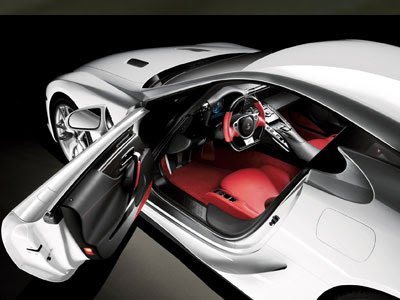
2011 Lexus LFA V10 engine Super Sport Car


Lexus LFA Super Sport Car

Power for the rear-wheel-drive Lexus LFA, which is constructed using advanced carbon fiber technology, comes from a mid-front mounted 4.8L V10 engine that red lines at 9,000 rpm and makes 552-hp with a maximum torque of 354 lb-ft. Mated to a 6-speed Automated Sequential Gearbox, the LFA goes from 0-62 mph in just 3.7 seconds (0-60 mph in 3.5 seconds) with a top speed of 202 mph.
Lexus LFA Super Sport Car

Lexus has finally taken the wraps of its new exclusive supercarthe 2011 Lexus LFA. “The LFA is a thoroughbred supercar, a machine engineered to achieve a single goal – to deliver a supreme driving experience,” said Chief Engineer Haruhiko Tanahashi.
The Lexus LFA coupe will be produced at the Motomachi plant in Toyota City. Toyota will make just 500 examples at rate of 20 units per month “to ensure the finest build quality and attention to detail.”
The UK launch price for the LFA is €368,000 (approximately £336,000).

Wednesday, November 4, 2009

The LF-A Roadster’s LEXUS V10 engine supercar Concept


LEXUS LF-A Roadster

The LF-A Roadster’s LEXUS V10 engine supercar Concept
.
Lexus will stage the Australian debut of its own supercar, the LF-A Roadster, at the Melbourne International Motor Show on 27 February.The LF-A Roadster goes on display in Melbourne after headlining motor shows in Tokyo and Detroit.
The Roadster’s V10 engine is capable of producing more than 360 kilowatts and test-track speeds greater than 330km/h.
Its sleek design utilises a lightweight carbon-fibre and aluminium body that ensures structural rigidity is maintained, even without a roof.
LEXUS LF-A Roadster

Styling of the LF-A Roadster draws extensively from the Lexus L-Finesse design philosophy and has been designed to deliver maximum aerodynamic efficiency.
The rear of the Roadster is marked by a pair of wrap-around, arrowhead-shaped taillights and a trio of centrally positioned exhausts.
To attain the best possible weight distribution, Lexus engineers positioned the radiators at the rear of the vehicle, which also allows for a sleeker front-end design.
The two rear-mounted radiators are fed cool air by two large intake ducts located forward of the rear wheel wells, and heated air is vented out behind the vehicle via a pair of large grilles.
The engine is mounted in a “front-mid” configuration – in front of the passenger compartment, but behind the front-axle centreline.
LEXUS LF-A Roadster

The engine is connected via a torque tube and propeller shaft to a transaxle that is controlled by paddle shifters. The torque tube is a structural member that adds rigidity to the drive train and chassis, while also reducing vibration.
The LF-A Roadster features wide high-performance tyres on turbine-styled alloy wheels.
The Melbourne International Motor Show is on at the Melbourne Convention and Exhibition Centre from 27 February to 9 March.


Wednesday, October 14, 2009

2009 LM5 McLaren Concept Car by Matt Williams


2009 LM5 McLaren Concept Car

The LM5 was designed as a vehicle which could rekindle the drama and sophistication of the legendary McLaren F1. And while McLaren have since revealed the MP4-12C supercar, it's not exactly in the same league as the technological tour-de-force which was the original F1.
The McLaren LM5 is a concept created by Matt Williams, a graduate of Coventry University's Transportation Design degree program. The LM5 was produced as his final year project.
The styling of the F1 was primarily dictated by function. However it also retained a unique sense of character and presence. Williams thought it would be interesting to develop the brand identity of McLaren - but more specifically the F1 model - and bring it into the 21st Century. And while the LM5 concept was designed to offer a similar personality and overall stance to the F1, it was also designed to utilize more extreme and race-influenced bodywork.
2009 LM5 McLaren Concept Car

The McLaren LM5 concept features the same three-seat layout with a central drivers seat as the old F1. All three sports seats have an extremely slim profile to reduce weight and free up interior space, and instead of conventional safety belts all the seats feature racing-style four-point harnesses. The multifunction steering wheel features a central display for the tachometer.
The proposed engine for the McLaren LM5 concept is a worked over 5.0 litre V10 sourced from BMW. Mounted midship in the carbon fibre pre-preg chassis this unit would make the LM5 a force to be reckoned with on both road and track.
While the LM5 is at the moment just one man's idea of what the F1's successor could look like, the design itself uses both past and present McLaren influences giving it a sense of realism. And It's important to remember that McLaren themselves have made it public knowledge that they're working on developing a successor to their most iconic car within the next couple of years.

Splinter Wooden Supercar the first supercar ever to be designed and engineered using wood


Splinter Wooden Supercar twin supercharged V8 engine

The Splinter is a very unusual and innovative vehicle. It's the first supercar ever to be designed and engineered using wood as the primary construction material. In the past some vehicles have used wood to various degrees in their construction, but never to the extent the Splinter does.
The Splinter is a graduate project by students at North Carolina State University. Wood has been used where possible, including the chassis, body, and even a large percentage of the suspension components and wheels.
While moving components like the suspension might seem impossible to fashion out of wood, the Splinter team realized that a leaf spring shares many traits with longbows, flexible, durable and with progressive spring rates. After research they decided to use Osage orange wood, which is the strongest wood found in North America. The front suspension therefore comprises of a laminated Osage orange wood leaf spring transversely mounted and providing suspension for both front wheels.
Splinter Wooden Supercar twin supercharged V8 engine

The wheels of the Splinter are made from rotary cut oak veneers. Each veneer was rotated 36 degrees from the previous layer to maximize grain direction alignment with the spokes. A walnut sunburst was cut for the front while a cherry sunburst was used on the back.
The mid-engined layout of the Splinter wooden supercar comprises of a 4.6 litre, twin supercharged V8 mated to a 6 speed manual gearbox and Getrag limited slip differential.
The Splinter is not intended for mass production, nor is it designed to break and performance or handling records. The design is merely to show that with intelligent and creative thinking a car can be created out of the most unlikely materials.

Tuesday, October 13, 2009

2009 Corvette ZR1 Supercharged V8 Engine The Super Sports Car


2009 Corvette ZR1 Supercharged V8 Engine

The engine purrs like a kitten and roars like a lion at top speed. The interior of the car is everything you would expect from a sports car. This will be the next car on the top of every collector's list. Once rumored to be the "Blue Devil", the ZR1 Corvette offers comfort and charm all wrapped into one package. It will not be easy to produce a follow up Corvette that can match it's speed and style.
The carbon roof adds a touch of class to the 2009 Corvette ZR1 and only increases it's world class sports car appearance. The body style is designed for speed with the supercharged engine, there is not problem reaching top speeds on a good dry road. Chevy has created a new breed of luxury sports car that will surpass all others in its' class and price range.
The easy to reach dashboard controls has improved in the 2009 Corvette ZR1. The driver will easily be able to control the heat and cooling as well as all other controls without much effort when traveling at high speeds. The interior is a simplistic and refined while the exterior is bold and distinguished. The bucket seats have a stylish two color design that really sets it apart from other Corvettes. Rest assured, the interior is set up with the sophisticated driver in mind and has plenty of room for a comfortable ride.
The 2009 Corvette ZR1 was promised to be the best Corvette Chevy has ever produced and from the looks of the car and the horsepower, they have succeeded in delivering a car that is all that and more. The price of the 2009 Corvette ZR1 will be worth every penny based on the shear style & muscle this car provides. For die-hard Corvette collector, the MSRP is well worth what you will receive in return. For non-diehard Corvette individuals, you also will be nothing short of amazed by what this vehicle has to offer vrs sports cars within its' class. Don't believe me? Take a ride to our dealership and check it out for yourself. You will be happy you did!
The 2009 Corvette ZR1 has ABS, vented disc brakes in the front and the back. The driveline is rear wheel drive with tires that were developed just for the 2009 Corvette ZR1. They are Michelin Pilot Sport 2, P285/30ZR19 for the front and P335/25ZR20 for the rear. The front bakes have 6-piston calipers and the back has 4-piston calipers. The rotor diameter is 15.5 for the front and 15 for the back.
2009 Corvette ZR1 Supercharged V8 Engine

2009 Corvette ZR1 Engine The engine is a LS9 Supercharged V8 with a displacement of 376 cubic inches with 620 's for horsepower. The car has 595 pounds of torque. The clock and cylinder head are made from cast aluminum. The bore and stroke is 4.06 x 3.62 inches. The valve train has two valves per cylinder with an overhead valve. The fuel is delivered by sequential fuel injection and the engine has a compression ratio of 9.1 to 1. The recommended fuel is premium.
The transmission is a six speed manual transmission with a dual disc clutch. Gears ratios are 2.29 to 1 for first, 1.61 to 1 for second, 1.21 to 1 for third gear and 1.00 for fourth, 0.81 to 1 for fifth and 0.67 to 1 for sixth gear. Reverse is 3.11 to 1. The final drive ratio is 3.42 to 1. The clutch offers great clamping power with easy effort. The top speed can be achieved in sixth gear in this car. The twin disc clutch uses two discs to spread the torque of the engine load over a wider area. This also helps to dissipate the heat more and helps with extending the life of the clutch, which is needed in this sporty little car.
The length of the car is 176.2 inches with a height of 49 inches and 75.9 inches wide. The wheelbase is 105.7 inches. The fuel rank is 18 gallons and the engine holds 12.5 quarts of oil. The speedometer will read out up to 220 miles per hour, which is very easy to do with the supercharged engine and twin disc clutch.
The 2009 Corvette ZR1 comes with Bluetooth connectivity, navigation system, leather wrapped interior and leather trimmed sport seats that are power adjusted. The car does offer four different colors for the interior. The car will come with its own unique VIN number that will tell how many were built for the specific year and model. Come test drive one today!


Saturday, October 3, 2009

Shelby Twin-Turbo V8 Engine Supercar Ultimate Aero

Shelby Twin-Turbo V8 Engine Supercar Ultimate Aero

Shelby Supercar engine in the base Aero model is same as the previous year, but the Ultimate Aero has a 6.35-litre (387.2 cu in) engine, rated at 1,183 bhp (882 kW) at 6950 rpm and 1,094 lb·ft (1,483 N·m) torque at 6150 rpm, and the supercharger is replaced by a twin turbocharger with cabin adjustable boost pressure. The car is designed to use 91-octane gasoline. The 6-speed transmission is readjusted to increase the theoretical top speed to 273.75 mph (437 km/h) at 7200 rpm, however whether the vehicle is able to reach this speed is highly questionable and has never been tested.
Twin-Turbo V8 Engine with 1183 hp, base price is $654,400. Tested in March 2007 by Guinness world records
Wheels on the base model are sized 18-inch at the front and 19-inch at the rear, while the Ultimate Aero TT has wheels an inch larger at each end.
The 2007 models are heavier, with the base model weighing 2,850 lb (1,290 kg), and Ultimate version 2,750 lb (1,250 kg). Unlike the previous year, base models have a navigation system, 10-speaker audio/CD/DVD system, video/DVD screen, back-up camera, air-conditioning, and trunk space as standard equipment. These come optional on the Ultimate.
The first production 2007 Ultimate Aero TT car was sold on eBay for US $431,100. Later cars are expected to cost US $654,000. Only 24 Ultimate Aero TT's are going to be produced from 2006-2007. The Ultimate Aero TT made its international debut on the International Show Circuit in November 2006, culminating with the world record top-speed competition held in Wolfsburg, Germany in May 2007.

Friday, October 2, 2009

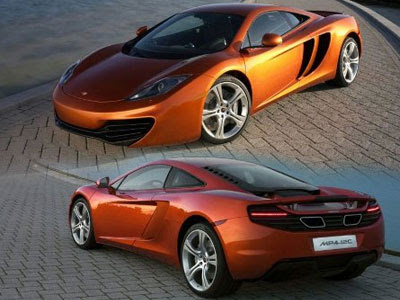
2011 McLaren MP4-12C Super Sport Concept Car

2011 McLaren MP4-12C Super Sport Concept Car

McLaren Automotive officially presented MP4-12C supercar, previously known under the code name P11 and is the first car from the time of the legendary F1.
Double mid McLaren MP4-12C was completed “in one piece” carbon chassis, which carries the aluminum and special plastic body panels. Eight-installed 3.8-liter engine with an angle of 90 degrees to the collapse of the cylinders and the two turbines. Its capacity is about 600 horsepower and maximum torque is 595 Nm (80 per cent of which is already available from 2000 rpm).
The motor will be used with the seven-Graziano robotized transmission with dual-clutch transmission and a choice taxied. According to preliminary data from the ground up to “hundreds” McLaren supercar will drive for about three seconds. Its top speed of 320 kilometers per hour.
Sales of McLaren MP4-12C, which is scheduled to release a limited edition of one thousand copies, will be no earlier than 2011. The car will do to the markets of USA, UK, Germany, Europe and the Middle East.

Wednesday, May 13, 2009

Aston Martin V-12 Vantage

Aston Martin unveiled the production version of its most potent and focused car at Geneva. This new car combines the V-8 Vantage's compact 2-seat dimensions with the power of the company's 5.9-liter V-12—to the tune of 510 bhp and 420 lb.-ft. of torque. Aston is predicting a 190 mph top speed, along with 0–62 mph (100 km/h) dispatched in a scant 4.2 seconds.
Although the V-12 engine weighs 220 lb. more than the standard car's V-8, carbon-ceramic brakes, lighter forged aluminium wheels, lightweight inner rear quarter panels and optional lightweight seats have resulted in the overall curb weight that's only 110 lb. heavier than its V-8 sibling's. And the weight distribution is near perfect, at 51/49 front/rear.

"More" has to be taken with a pinch of salt, as Aston only expects to build 300–500 examples a year at its Gaydon factory. Deliveries will begin this fall.

In A meanwhile,Aston Martin will return to the Nurburgring for the fourth year in a row to compete in the 24-hour endurance race. This year the new V12 Vantage will be joining the yellow V8 Vantage - nicknamed 'Rose' - on the grid.

The ADAC Nurburgring 24-hour race attracts a variety of entrants from factory backed teams (including Aston Martin, VW and Audi) to private entries in anything from Porsche 911 GT3s and BMW M3 GTS to more modest machinery. The strangest entry in last year's race was probably the Opel Astra Caravan, which finished ahead of a Lamborghini Gallardo!

This year Aston Martin will enter a V12 Vantage, driven by Chief Executive Dr Ulrich Bez along with members of Aston's engineering team. The car is described as being 'near standard specification', which means about 510bhp from a 6.0-litre V12. Changes include reduced weight, which necessitates re-tuned suspension and Pirelli has provided slick tyres for the race.

Wednesday, March 11, 2009

Lamborghini Insecta Concept

It’s a Lambo with extra bite! Meet the Lamborghini Insecta Concept, the brainchild of Romanian design student Iulian Bumbu. The Milan-based designer claims the car is a fusion of the Italian carmaker's current design language and the exoskeletons, or body armour, found on insects.

Insects to be the inspiration for future Lamborghini’s? That’s what one industrial design enthusiast was thinking about when he turned up this design study of what a future Lamborghini might look like. This supercar is still the concept car and is cleverly dubbed the Lamborghini Insecta and is structurally made of carbon fiber.Rumours said,this supercar, is to be powered by the same V10 powerplant that powers the Gallardo though we’re hoping it’ll feature more power, after all, insects are capable of some pretty amazing things.

And the two-seater mid-engined supercar certainly has a bug-like quality to it – with it’s tightly-wrapped carbon-fibre bodywork, wide-set eyes and winged scissor doors.Iulian Bumbu, the industrial design enthusiast of Romania explains in pure designer language, “The idea was to create an extreme race-oriented supercar with a style that introduces softer and more organic lines and integrate them into the geometrical style of Lamborghini.”Apparently the exoskeletons of insects gave Bumbu the idea for the external structure of the car. According to him, he tried ot to deviate too much from Lambo’s new design language but what will really be interesting is the response from Lamborghini Brand and Design Director, Manfred Fitzgerald.

Monday, March 2, 2009

Audi TT RS


A supercar manufactured by Audi,the Audi TT RS is to be officially revealed at next month’s Geneva Motor Show but the power of the internet again prevails as we now have official shots and an audio clip of the TT RS.This supercar will be powered by a 2.5-liter five cylinder turbocharged powerplant. Officially Ingolstadt’s hottest ever TT model, it is also a tribute to the spirit of the original Quattro model of the 80’s.

The new addition to the RS line up is good for some very impressive numbers - 340hp and a max torque of 450Nm, 0-100 in under five seconds and an electronically limited top speed of 250km/h. All that power is channel to all four wheels - or Quattro all wheel drive system in Audi lingo - through a six speed manual gearbox.

On the outside, the TT RS gets a rather subtle treatment over the 272HP TT S model that includes slightly larger front air vents, a distinctive rear diffuser, a fixed boot spoiler and twin-spoke alloy wheels. Inside, there’s a leather multifunction sports steering wheel and sports seats in a combination of Alcantara and leather. Check out the gallery below, more details on this next week.

Tuesday, February 17, 2009

The 2009 Caparo T1

Even this supercar had been involved in a fiery incident with a Fifth Gear host, scared the Top Gear’s Jeremy Clarkson and is generally completely impractical, the 575hp (429kW) Caparo T1 still exudes a sort of animal magnetism.

The 1000hp/tonne power-to-weight ratio doesn’t hurt the experience. That’s roughly double the ratio of the Bugatti Veyron, and enough to rocket the car to 60mph (96km/h) in less than 2.5 seconds, and on to 100mph (160km/h) in under 5. But perhaps the most impressive stats of the Caparo T1 are the lateral and braking force figures: up to three times the force of gravity throws the driver left, right and forward.This supercar full details on the 2009 version of the car have yet to be released, but Caparo has revealed five new levels of specification will be available. The entry-level variant is a stripped-down race track-only version, while a Race Extreme variant gets upgraded electronics, the most powerful engine package fully carbon brakes and super-lightweight magnesium wheels.

Source: Motor Authority

Tuesday, February 10, 2009

Volkswagen Golf R20T

Volkswagen first hinted at a new high-performance version of the Scirocco coupe when it revealed the GT24 race concept back at the Austrian Wörthersee Tour tuning show in May, but in what form the car will finally come to production is still up in the air. A report from AutoExpress suggests that the Volkswagen brand has finally succumbed to pressures by canning the 3.2-litre naturally aspirated V6 in favour of its trusted 2.0-litre turbo. This move applies to the range-topping Golf which is not the GTI but the R32. What's more is that the name R32 will disappear along with the engine to which it referred. Instead the car will likely be called the R20T and its chief rivals will be the Ford Focus RS, VW Group cousin the Audi S3 and the Subaru Impreza STI.

According to CAR, the new R20T will go on sale in Europe in early 2010 and will closely match the styling of the GT24 race concept. Key features likely lifted from the concept include the aggressively styled bumper with larger intakes and unique fog lights, as well as the slightly wider fenders and lower ride height.

By tweaking the 2.0-litre's ECU about 270bhp (201kW) can be extracted, which is similar to the Audi S3's power output of 265bhp from the same engine. A high-performance Scirocco R20T is also expected to use the same engine. The car will not only have more power than the current V6's 250bhp (186kW) but also weigh less as a result of the smaller engine. Thus improved performance overall and fewer C02 emissions can be expected. Whether a 4WD system or FWD will be used remains to be seen. However two gearboxes will be mated to whichever system is chosen, these being the 6-speed manual and DSG.

Styling is likely to be similar to that of the GTI and include LED daytime running lights, a sportier front bumper, flared wheel arches, and an underbody diffuser. The twin pipes located at the rear bumper centre remain in place but because the V6 is no more a similar sound will be engineered.

Saturday, February 7, 2009

GT-R Updated Launch Control

Nissan had updated the software that governs the GT-R’s launch control and was instructing all of its dealers to reprogram every vehicle in dealer inventory that had yet to be sold with the new software in a bid to keep additional transmissions from grenading.

The changes to the new software including limit the maximum RPM that the car will sustain with the VDC switched off to around 3,500, a big reduction from the 4,500 limit of the old programming. Additionally, the software update adds a new, safer form of launch control that allows takeoffs at 3,000 RPM while the VDC remains active.

We have some good news to share with Godzilla owners that are contemplating whether or not to have their cars updated with the new software. A bone-stock GT-R with the reprogramming has been timed at 11.34 @ 194.5km/h with an excellent -1.69-second 0-100 time. That result compares rather favorably with quarter-mile runs recorded by cars with the initial launch control programming.

Monday, February 2, 2009

First Official Rendering Of Aston Martin Rapide

The Rapide’s front and rear aspects are closest to the Vantage V8, not the DBS or DB9. The front air dam features just one lower intake, the trunk valance is flush with the car, and the tailpipes flank the rear diffuser area. Those are all Vantage cues.

This supercar is 5-meter long car will be power by a 6.0-liter V12 engine, but slot exactly in between the DB9 and DBS in output with 480 hp. Autocar suggests this will get the car to 60 mph in 4.5 seconds, but that could be optimistic – those 30 additional horses over the DB9 have to pull 286 more pounds, which will make it a challenge to outrun the middle sibling.

Not that it’s really meant to. The Rapide is Aston luxury for four, so it is taller than the DBS in order to provide more rear headroom for the “young adults” that can fit back there. The rear doors open wider than the front for ease of entry and the front seats have been raised to make room for the feet of back seat passengers. It even has a wagon-like folding rear bulkhead and parcel shelf. The Rapide will be appearing in the fourth quarter of the year when, with all hope, a better buying climate awaits it.
source:autocar

Volkswagen Concept BlueSport

The Concept BlueSport manufactured by German car company,Volkswagen is powered by a mid-mounted 2.0-liter turbodiesel that cranks out 180 bhp and 258 lb ft of torque. The power is delivered to the rear wheels via a 6-speed dual clutch transmission. The tidy Concept BlueSport measures just 157.1 inches in overall length, stands 49.6 in. tall and is 68.7 in. wide. The mid-ship engine location gives the car a front/rear weight distribution of 45/55. The Concept BlueSport rides on an independent front MacPherson strut and rear multilink suspension and features 19-in. wheels and tires.

The styling of the vehicle embodies the new design philosophy introduced by Volkswagen on the Golf and Scirocco—the front of the car has a thin horizontal grille element above the bumper and large open intakes below. The car sports clean, simple lines that are athletic and blend in with the aggressive front and rear wheel arch flares.

The Concept BlueSport is equipped with leather-clad bucket seats, a roll-bar and a manually operated soft top. In addition to delivering outstanding fuel economy (35 mpg city/50 highway for 42 mpg combined), the turbocharged diesel engine’s long suit is torque. The abundant amount of twist from 1750 rpm enables the car to sprint to 60 mph in just 6.2 seconds. And with an 18.5-gallon fuel tank, VW estimates a theoretical range of 710 miles—so you can go fast and far.

Tuesday, January 27, 2009

Bentley teases biofuel supercar

Bentley will take a large share of the spotlight with the vehicle you see above. It has no name yet, and no technical specifics have been released, but what Bentley has revealed is that this will be the marque's fastest, most powerful production car yet.And while the fuel price is increasing from one day to another day,this Bentley Supercar will runs on biofuel. Visually, the grilles all have a blackout treatment, and sizable vertical intakes occupy the front bumper's outer edges. The hood also sports a pair of vents, presumably to help extract engine heat.

Given that the 600-horsepower/553-lb-ft Continental GT Speed currently owns the "most powerful production Bentley" title, look for more extreme ratings on this new, obviously Continental-based monster. As for the biofuel half of the equation, we expect to see an ethanol-drinking version of the twin-turbocharged W12 that propels the rest of the Continental range.

Source: Bentley